Do Not Publish on Day One: The Setup Week Before Your First Video
The sequence is almost always identical. Somebody decides to start a channel, creates it that evening, finishes the first video the same week, and publishes immediately because waiting feels like wasting momentum.
Then they refresh. Ten views. Twenty. Fifty. A few days later, still fifty.
At which point the conclusions arrive, and they are always about somebody else: the algorithm does not like new channels, this niche is saturated, YouTube has got too hard. I have heard all three from people whose actual problem had nothing to do with any of them.
Their problem was that they had no process yet. So the advice I give every person starting from zero is boring and unpopular: do not publish the day you create the channel. Give yourself about a week first.
What the week is, and what it is not
Let me kill the obvious misreading straight away. This is not “create the channel and leave it alone to age”. It is not a trick that persuades anything to treat you differently, and I want to be completely clear that YouTube has never said anything of the sort. If somebody has told you that waiting a week improves your distribution, they made that up.
The week is for you. It is the time in which you turn an intention into a working system – the channel finished properly, several videos ready to go, a schedule you can actually keep, and a subject you have thought about for longer than one excited evening.
The benefit is entirely practical, and it is the difference between a channel that is still publishing in month four and one that quietly stopped in week three.
Why the first weeks really go wrong
It is almost never laziness. The people who fail early are usually working extremely hard – that is what makes it painful to watch.
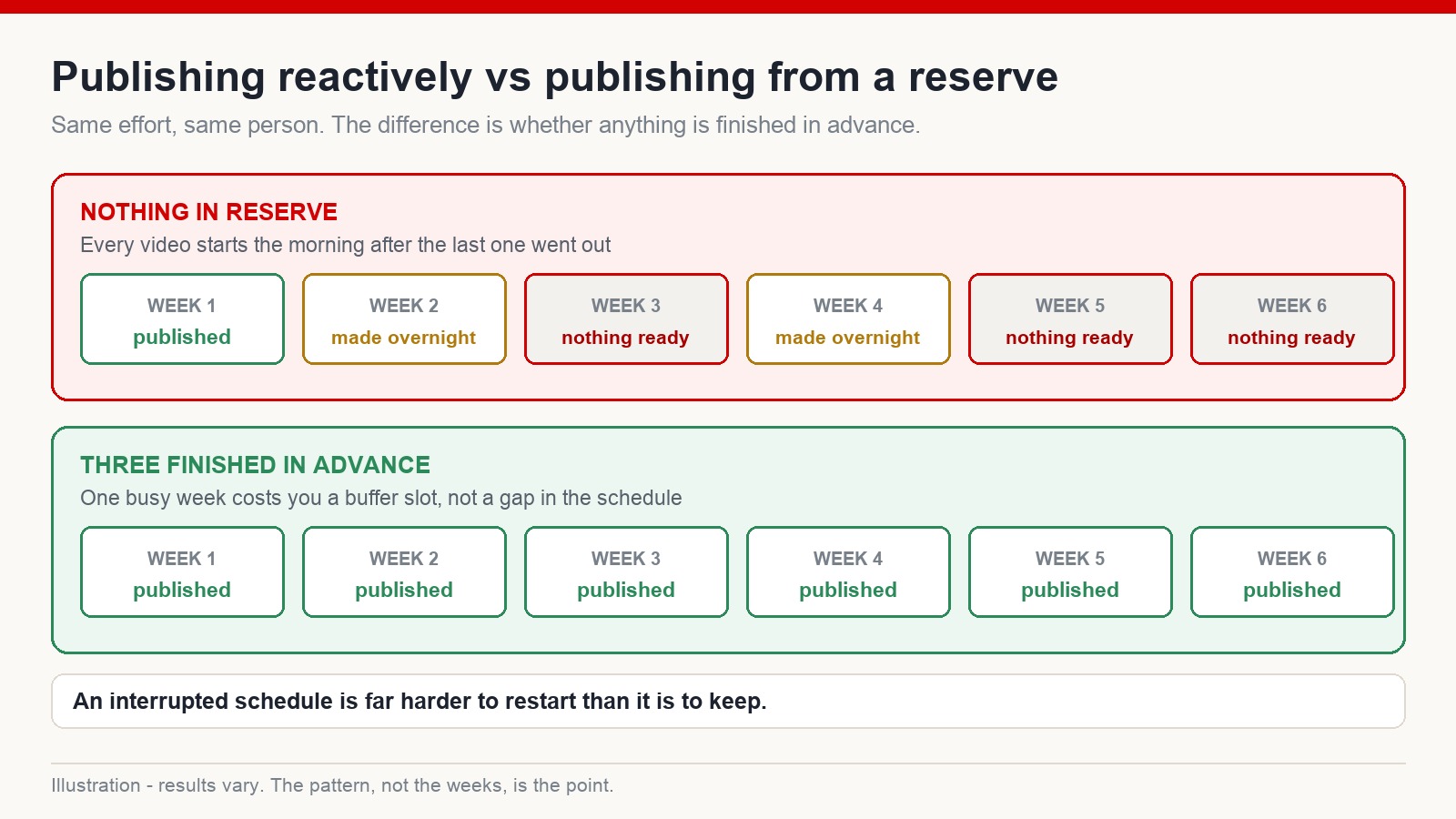
The failure is structural. You publish video one. The next morning you start thinking about what video two should be. The day after that you begin writing it. Then editing takes longer than expected. Then the thumbnail. By the time you are supposed to publish again, nothing is ready, the gap stretches, and the schedule you announced to yourself quietly dissolves. Every video is produced reactively, under pressure, at the last possible moment.
That is not a content problem. It is a pipeline problem, and it is entirely solvable before you publish anything at all.
What to actually do with the seven days
This is the part that matters, so here is how I would spend it.
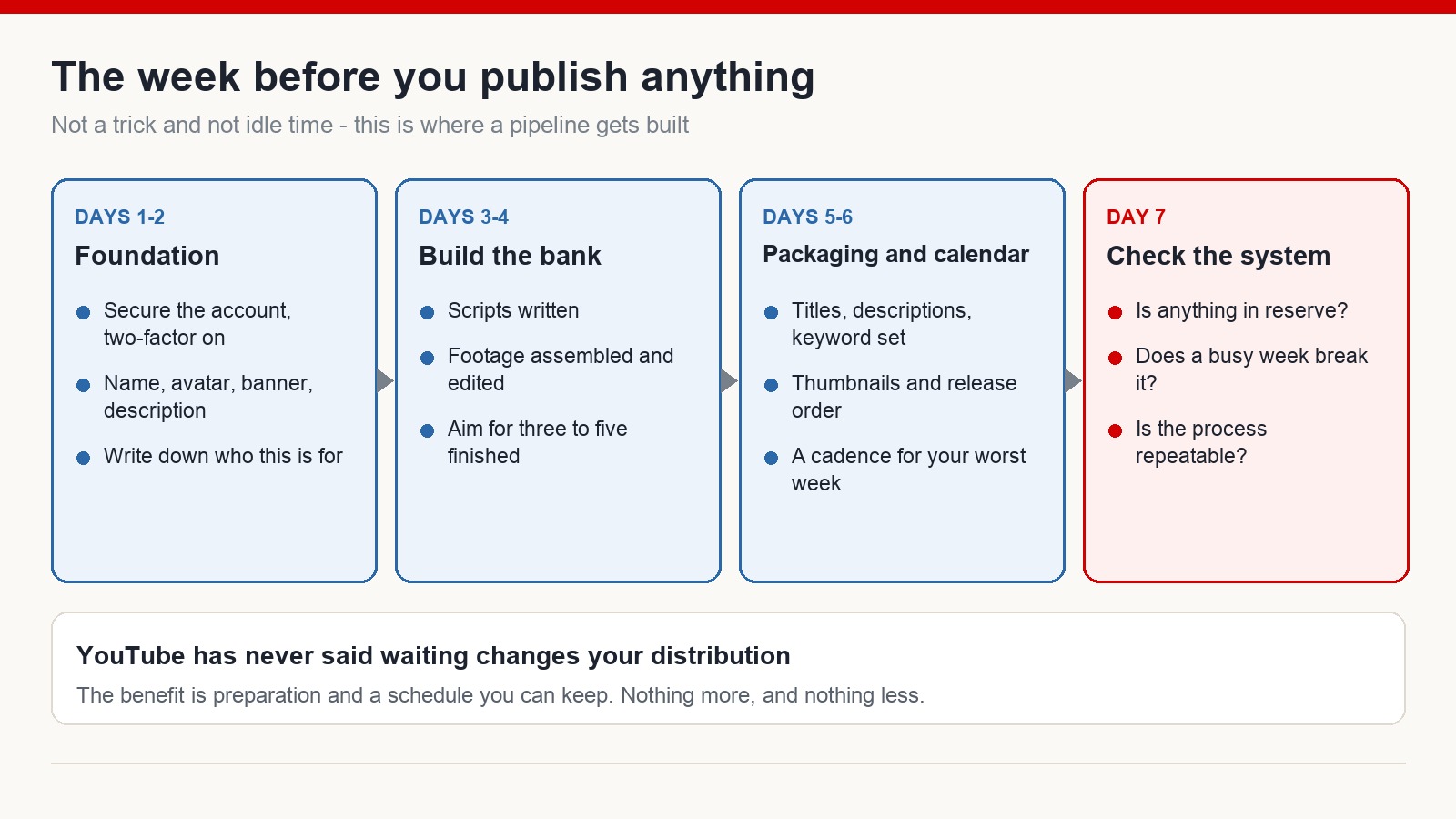
Days one and two: the foundation
Set the channel up on an account that is properly secured and that you will still control in three years – two-factor enabled, recovery details current. Choose a channel name you can live with. Make an avatar and banner that look deliberate rather than default. Write the channel description in the words your audience uses. And write down, for yourself, exactly who this channel is for and what it publishes.
That last item takes ten minutes and prevents months of drift.
Days three and four: build the bank
Do not stop at one video. Get as far as you can toward having several finished or nearly finished: scripts written, footage assembled, thumbnails designed, working titles chosen.
The aim is a small stock of ready material so that when you begin publishing you are drawing from a reserve rather than sprinting to fill a slot. Three to five is a reasonable target. Even two changes the experience enormously.
Days five and six: the packaging and the calendar
Now go back over what you have made and treat the packaging as its own job rather than an afterthought. Titles, descriptions, the keyword set, thumbnails, and the order you intend to release them in.
Then set a schedule you can keep on your worst week, not your best one. A cadence you can sustain when work is busy beats an ambitious one you abandon in a fortnight.
Day seven: check the system
Sit down and answer three questions honestly. Do I have videos in reserve? If next week turns out to be chaotic, does anything still go out? Is my production process repeatable, or did the first video only get finished because I had unusual amounts of time?
If the answers are yes, publish. If they are not, you have just learned something about your plan that would otherwise have cost you a month.
The three things that go wrong without it
No buffer. You publish and immediately owe yourself the next one. There is no slack in the system, so any interruption – illness, work, a bad week – becomes a visible gap.
A broken cadence. Two or three busy days is all it takes. The problem is less about how the platform reads inconsistency and more about what it does to you: an interrupted schedule is remarkably hard to restart, and most people never do.
Conclusions drawn from nothing. After three videos with low view counts people decide the niche is dead or the algorithm is against them. Three videos is not a sample. You are making a judgement with no data and, worse, acting on it – usually by changing everything, which guarantees you never learn what was working.
Three conditions before the first upload
If you want a simple test for readiness, it is this.
The channel is finished. Name, avatar, banner, description, and a clear subject. Nothing on the page says “I set this up in a hurry”.
There is material in reserve. At least a couple of completed videos beyond the one you are about to publish.
There is a working rhythm. You know which days you produce, which days you edit, when you publish and when you sit down to read what the data said.
When those three are true you have stopped making YouTube videos when inspiration arrives and started running a process. That transition is the entire point of the week.
A different way to think about the race
A lot of people treat this as a competition to publish first, as though the subject might be taken. It will not be. There is no shortage of demand for a well-made video on a subject people care about, and being three weeks earlier with something rushed has never beaten being three weeks later with something you can sustain.
Creating a channel is not the beginning of publishing. It is the beginning of building something that still exists in a year – and a week spent preparing does not make you slower. It usually saves you months of flailing.
None of this guarantees an outcome, obviously. Plenty of well-prepared channels still take a long time to find an audience, and platform behaviour changes without warning. What preparation does is remove the failures that are entirely within your control, which is the only category worth worrying about.
Frequently asked questions
Do I have to wait exactly seven days?
No. Seven is a convenient container, not a rule, and it is certainly not a YouTube requirement. The point is to publish when the system is ready, whether that takes four days or three weeks.
Does waiting improve how my videos are distributed?
There is no evidence for that and no statement from the platform supporting it. The benefit is preparation and consistency, nothing more.
How many videos should I have before publishing?
Three to five finished is comfortable. Two is workable. One means you are already behind on the day you start.
What should a beginner focus on most?
Building a repeatable production process and improving each video, rather than hunting for techniques that promise faster growth.
I already published on day one. Have I ruined it?
No. Nothing here is irreversible. Pause new uploads, spend a week building a reserve, and restart with a cadence you can actually hold.
If you want a structured way to work through this rather than assembling it alone, that is what we do at mmoyoutube.com.